| Melancholy of the Evening -- The forest, which widens deceased -- And shadows are around it, like hedges. The deer comes trembling out of hidden places, While a brook glides very quiet And follows ferns and ancient stones And gleams silverly from tangled foliage. Soon one hears it in black gorges - Perhaps, also that stars already shine. The dark plain seems endless, Scattered villages, marsh and pond, And something feigns a fire to you. A cold gleam shoos over roads. In the sky one anticipates movement, An army of wild birds migrates Towards those lands, beautiful, distant. The stirring of reeds rises and sinks. Trakl | Melancholie Des Abends – Der Wald, der sich verstorben breitet – Und Schatten sind um ihn, wie Hecken. Das Wild kommt zitternd aus Verstecken, Indes ein Bach ganz leise gleitet Und Farnen folgt und alten Steinen Und silbern glänzt aus Laubgewinden. Man hört ihn bald in schwarzen Schlünden – Vielleicht, daß auch schon Sterne scheinen. Der dunkle Plan scheint ohne Massen, Verstreute Dörfer, Sumpf und Weiher, Und etwas täuscht dir vor ein Feuer. Ein kalter Glanz huscht über Straßen. Am Himmel ahnet man Bewegung, Ein Heer von wilden Vögeln wandern Nach jenen Ländern, schönen, andern. Es steigt und sinkt des Rohres Regung. Trakl |
Showing posts with label Poets. Show all posts
Showing posts with label Poets. Show all posts
Sunday, October 03, 2010
Melancholy of the Evening
Sunday, March 18, 2007
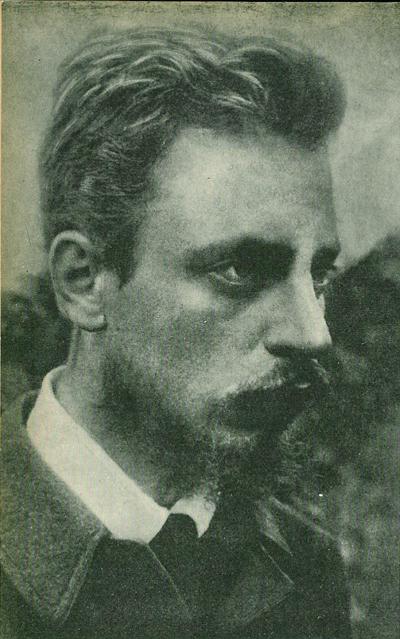
Rilke, On the evening of 12 April 1900
 |
photo courtesy of Victor Alvarez |

enriched by your silence's weight,-
it may be that you'll know yourself well
and feel: I am a teacher of mankind.
Yet nothing corrupts so much as this:
to approach people as instructor.
You stand at the edge of their looks
and read their hidden hatred.-
And you interpret it to your advantage.
But you're lying: they despise you.
And ever since that lie crept up on you,
you've grown devoid of mastery,
and your house is just like the others.
Whoever would truly master people,
let him go far away from them, quietly,
and let his serenity be unvoiced;
for no one can penetrate the workings
of his own time. To every sage
its fate, its sorry, is an enigma.
All he experienced is that force
from which the times, departing quietly,
make their way toward mankind.
And forever branded by this knowledge,
he may not ever grasp the others.
That's why to do this very day
no word of any triumph has arrived:
no teacher has ever kept silent,
and no wisdom has ever been attained
by this waivering one, by shame.-
Thus we became dreamy violinists
who softly step out of their doors
to make sure, before they pray,
that no neighbor eavesdrops on them.
Who only, when all people have dispersed,
behind the last sounds of evening
play the song behind which-
like woods in the wind behind fountains-
the dark violin-case murmurs.
For voices are only worth anything
when silences accompany them;
when behind the speech of the strings
rushings remains as if from blood;
and unendurable are those times when
behind all the vanities and strutting masks
there is no ruling force that rests.-
Patience: the gentle clock hand circles,
and what was promised will come about;
we are the whisperers before the silent one,
we are the meadows before the wood;
they still resonate with a dark humming,-
voices everywhere and yet no choir-
and they help prepare us for the mute, deep,
everpresent holy groves...
AND if sometime you have to teach-
because you have a child, one who sits waiting,
or because in the evening a guest,
one dark with grime,
walks up to the edge of your lamp,
or because your stride
falters once
and you have to stay until daybreak
among strangers,
or because a friend from times past, one who feels
the long-ago friendship tottering,
implores you
to write him sometime soon-
that's when you'd better whisper to yourself
what "teaching" means:
with words that are at your call
to say: I am.
And then furthermore
what "teaching" means:
with words that are at your call
to say: I am.
And the furthermore
what teaching doesn't mean: to lecture
every man of the tumble of times,
on the how and wherefore of their succession;
teaching means; to ask of each person
what he feels closer to in silence...
Whoever would truly master people,
let him go far away from them, quietly,
and let his serenity be unvoiced;
for no one can penetrate the workings
of his own time. To every sage
its fate, its sorry, is an enigma.
All he experienced is that force
from which the times, departing quietly,
make their way toward mankind.
And forever branded by this knowledge,
he may not ever grasp the others.
That's why to do this very day
no word of any triumph has arrived:
no teacher has ever kept silent,
and no wisdom has ever been attained
by this waivering one, by shame.-
Thus we became dreamy violinists
who softly step out of their doors
to make sure, before they pray,
that no neighbor eavesdrops on them.
Who only, when all people have dispersed,
behind the last sounds of evening
play the song behind which-
like woods in the wind behind fountains-
the dark violin-case murmurs.
For voices are only worth anything
when silences accompany them;
when behind the speech of the strings
rushings remains as if from blood;
and unendurable are those times when
behind all the vanities and strutting masks
there is no ruling force that rests.-
Patience: the gentle clock hand circles,
and what was promised will come about;
we are the whisperers before the silent one,
we are the meadows before the wood;
they still resonate with a dark humming,-
voices everywhere and yet no choir-
and they help prepare us for the mute, deep,
everpresent holy groves...
On the same evening
AND if sometime you have to teach-
because you have a child, one who sits waiting,
or because in the evening a guest,
one dark with grime,
walks up to the edge of your lamp,
or because your stride
falters once
and you have to stay until daybreak
among strangers,
or because a friend from times past, one who feels
the long-ago friendship tottering,
implores you
to write him sometime soon-
that's when you'd better whisper to yourself
what "teaching" means:
with words that are at your call
to say: I am.
And then furthermore
what "teaching" means:
with words that are at your call
to say: I am.
And the furthermore
what teaching doesn't mean: to lecture
every man of the tumble of times,
on the how and wherefore of their succession;
teaching means; to ask of each person
what he feels closer to in silence...


Saturday, March 17, 2007
Please Call Me By My True Names
 Do not say that I'll depart tomorrow
because even today I still arrive.
Look deeply: I arrive in every second
to be a bud on a spring branch,
to be a tiny bird, with wings still fragile, learning to sing in my new nest,
to be a caterpillar in the heart of flower,
to be a jewel hiding itself in a stone.
I still arrive, in order to laugh and to cry, in order to fear and to hope,
the rhythm of my heart is the birth and death of all that are alive.
I am the mayfly metamorphosing on the surface of the river,
and I am the bird which, when spring comes, arrives in time to eat the mayfly.
I am the frog swimming happily in the clear water of a pond
and I am also the grass-snake who, approaching in silence, feeds itself on the frog.
I am the child in Uganda, all skin and bones, my legs as thin as bamboo sticks,
and I am the arms merchant, selling deadly weapons to Uganda.
I am the 12 year old girl, refugee on a small boat,
who throws herself into the ocean after being raped by a sea pirate,
and I am the pirate, my heart not yet capable of seeing and loving.
In am a member of the politburo, with plenty of power in my hands,
and I am the man who has to pay his "debt of blood" to my people
dying slowly in a forced labor camp.
My joy is like spring, so warm it makes flowers bloom in all walks of life.
My pain is like a river of tears, so full it fills up the four oceans.
Please call me by my true names,
so I can hear all my cries and my laughs at once,
so I can see that my joy and pain are one.
Please call me by my true names, so I can wake up,
and so the door of my heart can be left open
the door of compassion.
-by Thich Nhat Hanh
Monday, March 12, 2007
Rilke's "The Ninth Elegy"
 Why, if it's possible to spend this span
of existence as laurel, a little darker than all
other greens, with little waves on every
leaf-edge (like the smile of a breeze), why, then,
must we be human and, shunning destiny,
long for it?...
Oh, not because happiness,
that over-hasty profit of loss impending, exists.
Not from curiosity, or to practise the heart,
that would also be in the laurel...
but because to be here is much, and the transient Here
seems to need and concern us strangely. Us, the most transient.
Everyone once, once only. Just once and no
more.
And we also once, Never again. But this having been
once, although only once, to have been of the
earth,
seems irrevocable.
And so we drive ourselves and want to achieve it,
want to hold it in our simple hands,
in the surfeited gaze and in the speechless heart.
want to become it. give it to whom? Rather
keep all forever...but to the other realm,
alas, what can be taken? Not the power of seeing,
learned here so slowly, and nothing that's happened here.
Nothing. Maybe the suffering? Before all, the heaviness
and long experience of love--unutterable things.
But later, under the stars, what then? They are better
untold of.
The wanderer does not bring a handful of earth,
the unutterable, from the mountain slope to the valley,
but a pure word he has learned, the blue
and yellow gentian. Are we here perhaps just to say:
house, bridge, well, gate, jug, fruit tree, window--
at most, column, tower... but to say, understand this, to say
it
as the Things themselves never fervently thought to be.
Is it not the hidden cunning of secretive earth
when it urges on the lovers, that everything seems transfigured
in their feelings? Threshold, what is it for two lovers
that they wear away a little of their own older doorstill,
they also, after the many before,
and before those yet coming...lightly?
Here is the time for the unutterable, here,
its country.
Speak and acknowledge it. More than ever
the things that we can live by are falling away,
supplanted by an action without symbol.
An action beneath crusts that easily crack, as soon as
the inner working outgrows and otherwise limits itself.
Our heart exists between hammers,
like the tongue between the teeth,
but notwithstanding, the tongue
always remains the praiser.
Praise the world to the angel, not the unutterable world;
you cannot astonish him with your glorious feelings;
in the universe, where he feels more sensitively,
you're just a beginner. Therefore, show him the simple
thing that is shaped in passing from father to son,
that lives near our hands and eyes as our very own.
Tell him about the Things. He'll stand amazed, as you stood
beside the rope-maker in Rome, or the potter on the Nile.
Show him how happy a thing can be, how blameless and ours;
how even the lamentation of sorrow purely decides
to take form, serves as a thing, or dies
in a thing, and blissfully in the beyond
escapes the violin. And these things that live,
slipping away, understand that you praise them;
transitory themselves, they trust us for rescue,
us, the most transient of all. They wish us to transmute them
in our invisible heart--oh, infinitely into us! Whoever we are.
Earth, isn't this what you want: invisibly
to arise in us? Is it not your dream
to be some day invisible? Earth! Invisible!
What, if not transformation, is your insistent commission?
Earth, dear one, I will! Oh, believe it needs
not one more of your springtimes to win me over.
One, just one, is already too much for my blood.
From afar I'm utterly determined to be yours.
You were always right and your sacred revelation is the intimate
death.
Behold, I'm alive. On what? Neither childhood nor future
grows less...surplus of existence
is welling up in my heart.
Thursday, January 18, 2007
Rilke at the Castle

It was another winter. Rilke set his pen to the air and nothing. Duino Castle and its grand white and silver grounds, the promise of the nightingale. Nothing.
One day, as the princess tells it, a business letter arrived. Full of the numbers that other world and difficult to answer. He climbed down to the path by the cliff, thinking.
Then, a voice: “Who, if I cried out, would hear me among the angel’s hierarchies?”
And the letter was written, and the Duino Elegies.
The letter still arrives for each poet, as it did for Rilke, when the sky is the poet’s sky and the nightingale has promised, and yet nothing comes. What arrives is the letter, full of that other world and its ugly demands. And, somehow, when he dares to answer it, both worlds open.
Friday, September 15, 2006

| I went with Aunt Consuelo to keep her dentist's appointment and sat and waited for her in the dentist's waiting room.It was winter. It got dark early. The waiting room was full of grown-up people, arctics and overcoats, lamps and magazines. My aunt was inside what seemed like a long time and while I waited and read the National Geographic (I could read) and carefully studied the photographs: the inside of a volcano, black, and full of ashes; then it was spilling over in rivulets of fire. Osa and Martin Johnson dressed in riding breeches, laced boots, and pith helmets. A dead man slung on a pole "Long Pig," the caption said. Babies with pointed heads wound round and round with string; black, naked women with necks wound round and round with wire like the necks of light bulbs. Their breasts were horrifying. I read it right straight through. I was too shy to stop. And then I looked at the cover: the yellow margins, the date. Suddenly, from inside, came an oh! of pain --Aunt Consuelo's voice-- not very loud or long. I wasn't at all surprised; even then I knew she was a foolish, timid woman. I might have been embarrassed, but wasn't. What took me completely by surprise was that it was me: my voice, in my mouth. Without thinking at all I was my foolish aunt, I--we--were falling, falling, our eyes glued to the cover of the National Geographic, February, 1918. I said to myself: three days and you'll be seven years old. I was saying it to stop the sensation of falling off the round, turning world. into cold, blue-black space. But I felt: you are an I, you are an Elizabeth, you are one of them. Why should you be one, too? I scarcely dared to look to see what it was I was. I gave a sidelong glance --I couldn't look any higher-- at shadowy gray knees, trousers and skirts and boots and different pairs of hands lying under the lamps. I knew that nothing stranger had ever happened, that nothing stranger could ever happen. Why should I be my aunt, or me, or anyone? What similarities boots, hands, the family voice I felt in my throat, or even the National Geographic and those awful hanging breasts held us all together or made us all just one? How I didn't know any word for it how "unlikely". . . How had I come to be here, like them, and overhear a cry of pain that could have got loud and worse but hadn't? The waiting room was bright and too hot. It was sliding beneath a big black wave, another, and another. Then I was back in it. The War was on. Outside, in Worcester, Massachusetts, were night and slush and cold, and it was still the fifth of February, 1918. Bishop's poem, one of my favorites, bites into that hard-to-describe moment when all naive philosophy halts and we find ourselves aware of the wild world in all its improbability. Why should it exist? Why should I exist? How is it that I am one of them? Have you ever experienced this type of moment? When? |
Subscribe to:
Posts (Atom)